

It’s been nearly 20 years since two aviation technology students and their instructor — all experienced pilots — died in a plane crash at the Purdue Airport, but Tom Carney (T’71, MS A’77, PhD S’84) recalls the morning of September 12, 1997, vividly. Carney was one of two administrators who waited near the crash site for hours until emergency crews were able to remove the fallen aviators from the wreckage on what he calls “the longest and saddest day of my life.”
The deaths of Anthony Kinkade, 21, Julie Swengel, 21, and Jeremy Sanborn (T’95), 24, devastated the close-knit department. “A special bond connects everyone who’s experienced the gift of flight,” says Carney, who was associate department head of aviation technology at the time. “There was an immediate desire to honor the memory of those who lost their lives while preparing for their profession.”
Susan Hutson, a university architect serving as project manager for the construction of the Holleman-Niswonger Simulator Center, proposed installing a meditation circle anchored by an aircraft wing sculpture in front of the building. The entire memorial was constructed by students, faculty, and staff — from fabricating the airfoil to planting the greenery. “This landmark represents the heart and soul of the aviation technology department,” says Hutson. “It was a wonderful, collaborative effort.”
Verses of “High Flight,” penned by WWII fighter pilot John Gillespie Magee Jr. just a few months before he died in a mid-air collision at age 19, are engraved upon the sculpture. The poem begins with the line “Oh, I have slipped the surly bonds of earth,” and evokes the universal joy of flight.
“It’s something that is hard to understand unless you’ve experienced it,” says Carney. “Flying through the night with the Milky Way soaring above you or watching the sunrise from 41,000 feet … you witness incredible beauty and gain a deep sense of where you are in the cosmos.
“There’s a saying among pilots that we all have to ‘fly west’ at some point,” says Carney. The aviation memorial stands in lasting tribute to those pilots who made that westward journey before their time.
This story appeared in the May/June 2016 issue of Purdue Alumnus magazine.

Val Watts doggedly hunts an undruggable enzyme as target for chronic pain treatment
Val Watts enjoys a tricky puzzle. The associate dean for research and professor of medicinal chemistry and molecular pharmacology built his career attempting to find solutions to problems others have deemed unsolvable.
His latest white whale is a doozy. Watts wants to develop pain medications as strong and effective as opioids, without their addictive properties. To do so, he’s collaborating with other College of Pharmacy researchers to target the adenylyl cyclase enzyme, a signal pathway shared by opioid receptors and dopamine receptors.

Center for Health Excellence, Quality and Innovation launches Nutrition Hub at IU Health Methodist Hospital in Indy
Sufficient access to high-quality, nutritious food is necessary for overall health, but nearly 13% of U.S. households face food insecurity. A new initiative launched by the Center for Health Excellence, Quality and Innovation (CHEQI) in the College of Pharmacy aims to integrate nutrition and health care, raising awareness for the concept of food as medicine and providing patients with nutritious food tailored to their individual medical needs.
The Nutrition Hub, which opened at IU Health Methodist Hospital in Indianapolis in November 2023, is a partnership between CHEQI, the American Heart Association and Gleaners Food Bank of Indiana, the largest hunger relief organization in the state.

R’Kes Starling leverages technology to expand access to clinical trials for underrepresented populations
It all started with his mother. That’s how R’Kes Starling (BS ’02) attributes his inspiration for founding Reveles, an AI-powered patient engagement company that partners with drug sponsors and research institutions to increase awareness and expand clinical trial access to underrepresented patients. By prioritizing diversity within studies, Reveles helps to ensure marginalized communities do not miss out on life-changing care while simultaneously advancing a more equitable approach to health care.

Oldest and largest program in the country leverages industry partnerships to advance radiopharmaceutical training in Indianapolis
In 1946, nearly 50 years after the Polish physicist and chemist Marie Curie coined the term radioactivity, Purdue University received the first shipment of radioactive materials for use in the development of medical therapy from Oak Ridge National Laboratory in Tennessee.
John E. Christian (BS ’39, PhD HHS ’44), a professor of pharmaceutical chemistry, was conducting pioneering research in the emerging field of bionucleonics, a term that reportedly originated from then Purdue President Frederick Hovde to describe the biological application of nuclear physics. At the time, Christian was one of a handful of people in the country accomplishing meaningful work in peaceful uses of radioactive materials.

Identification of nuclear protein’s critical role in cell degradation could lead to prevention or even reversal of age-related diseases
Tantalizing legends of a fountain of youth spurred explorers to navigate the globe for millennia in search of the restorative waters that promised to wind back the hands of time and halt the process of aging. Recent research conducted in the Purdue University College of Veterinary Medicine and the Bindley Bioscience Center reveals the real secret lies not in myth, but in science.
As we age, our cells undergo senescence, a process where they cease dividing and enter a state of permanent growth arrest without dying off. Senescence is actually a good thing, because if cells continue to divide uncontrollably, they become tumorigenic or cancer-initiating cells. It’s when too many senescent cells build up that they cause problems.

Alumnus honors late wife by funding research for swallowing disorders
Dave Greulich (ME’67) never realized he believed in love at first sight until he met Dee.
A friend fixed the couple up on a blind date in their hometown of Louisville, Kentucky, a few weeks before Greulich left for his freshman year at Purdue. Deanna Schneider was an aspiring nurse with a gentle disposition who exhibited great empathy and care for others. Greulich was smitten. The pair continued to date while attending separate colleges and married on January 27, 1968.

Savoie research team builds largest dataset of reaction mechanisms in existence
Theoreticians have worked in tandem with experimentalists since the dawn of the scientific age. The advent of machine learning facilitated computational work on a larger scale and a faster timetable. While data about the properties of specific molecules has been available for years, predications of how those molecules would react in different environments and under various conditions remained elusive.
After developing the automated computational method YARP — Yet Another Reaction Program — two years ago, a research team led by Brett Savoie, the Charles Davidson Associate Professor of Chemical Engineering, applied YARP’s technology to build the largest dataset of reaction mechanisms in existence.

Promising initial research could lead to more effective seasonal flu shots and ward against future pandemics
Dry cough. Runny nose. Sore throat. Muscle aches. These symptoms are all familiar to anyone who’s contracted the common flu, a respiratory illness that affects one billion people each year. The Centers for Disease Control and Prevention recommend most people receive yearly flu shots because the seasonal influenza virus mutates constantly, creating new strains that circulate from person-to-person leading to seasonal flu epidemics. These yearly vaccines are formulated to protect against the specific virus strains expected to spread and cause illness during that flu season, typically October through May.
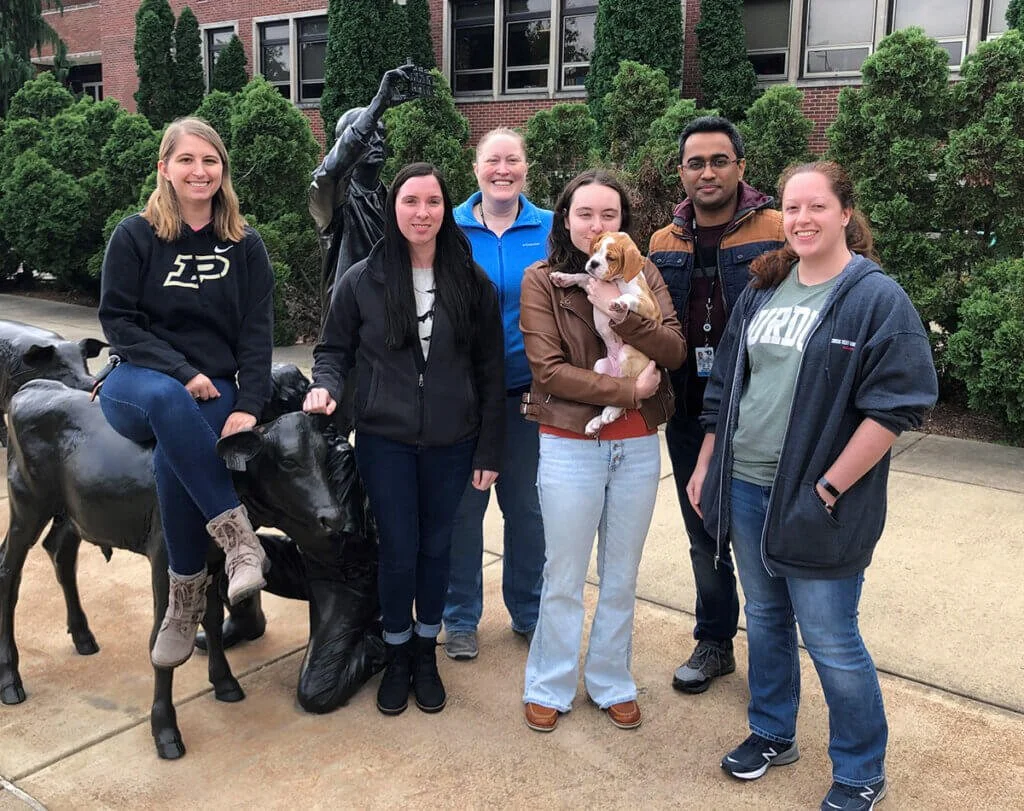
New genetic testing available through ADDL will help dog breeders eliminate specific diseases
Research findings by genetic scientists in the Purdue University College of Veterinary Medicine have the power to eradicate specific genetic diseases within certain dog breeds. Testing for the genetic mutations will be offered by the Animal Disease Diagnostic Laboratory (ADDL) at Purdue. As the first such tests offered to the general public for three new canine genetic diseases, these screenings will enable breeders to identify which dogs are carriers for a disease and could possibly pass it on to offspring. By ensuring two carriers are not bred together, the disease can be halted before it spreads throughout the breed.

Treatment in development by Adipo Therapeutics holds promise for millions who struggle with weight loss and blood glucose control
Eat less. Exercise more. It sounds so simple. But if it were that simple, America wouldn’t be facing the dual epidemics of obesity and diabetes.
Adipo Therapeutics, a Purdue Research Foundation-backed startup, is developing a unique treatment approach that turns bad fat into good fat. This disruptive nanotherapeutic delivery could provide a safe and effective way to treat obesity and Type 2 diabetes.